
When AI Learns from the Irreplaceable
What surgical training can teach us about mastery, talent development, and the limits of ordinary management.

In business, we are often taught not to depend on irreplaceable people.
If only one person can do the job, that is usually seen as a risk. Good organizations create processes, share knowledge, and build succession plans.
They try not to rely on one genius, one veteran, or one master.
That is sensible advice.
But surgery may be different.
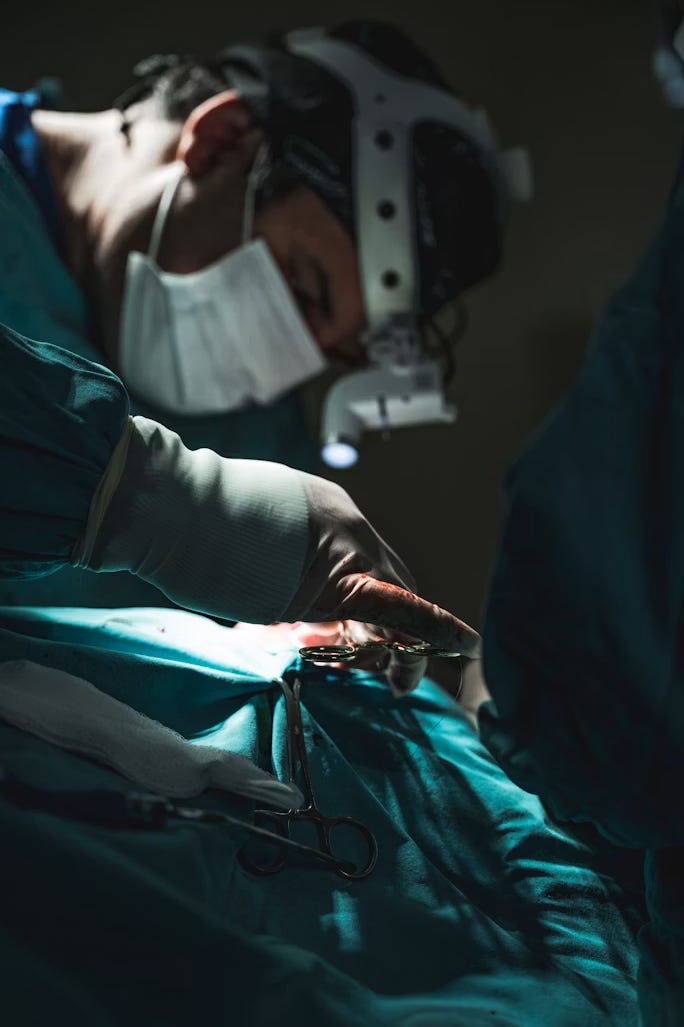
A recent Nikkei article reported that researchers at Nagoya University are developing an AI-based training method for microsurgery. Microsurgery involves suturing blood vessels and nerves as small as one or two millimeters, using threads thinner than human hair.
This is not just knowledge work.
It is work of the eye, the hand, the muscle, the wrist, the breath, and the nerves.
The AI analyzes surgeons’ gaze and muscle signals to evaluate their level of skill.
Highly skilled surgeons, it seems, show more repeatable patterns in muscle movement. Their eyes also reveal something about their mastery.
What interested me was not only the technology.
It was the management problem behind it.
Japan faces a shortage of young doctors entering demanding surgical fields.
Senior surgeons are busy. They cannot always spend enough time training the next generation. And because surgical learning depends on the cases one happens to encounter, experience is uneven.
In business language, this is a talent development problem.
But it is not the kind of problem solved by a leadership workshop or a competency framework.
It is the problem of transmitting mastery.
In ordinary organizations, we try to avoid dependence on “irreplaceable” people.
But in surgery, perhaps some people are irreplaceable for a reason. Their value is not just in what they know, but in what their bodies have learned.
The angle of the hand.
The steadiness of the wrist.
The discipline of the eyes.
The economy of movement.
These things are hard to write down.
This is where AI becomes interesting.
The usual story is that AI will replace experts.
But here, AI may first help us learn from experts more carefully.
It can observe what humans miss.
It can make invisible patterns visible.
It can give younger doctors feedback that was once available only through long apprenticeship.
That does not mean AI replaces the master.
At least not yet.
It may mean AI helps preserve the master’s craft before it disappears.
There is a lesson here beyond medicine.
The most valuable knowledge in any organization is often not information.
It is judgment, timing, attention, sensitivity, and pattern recognition.
The best teacher senses confusion before it is spoken.
The best negotiator knows when silence is working.
The best leader knows when a team has agreed in words but withdrawn in spirit.
These forms of mastery are difficult to standardize.
But perhaps they can be made more visible.
In business, we are right to be cautious about depending too much on irreplaceable people.
But we should also ask a harder question.
Is this person irreplaceable because the organization is badly designed?
Or because they carry a form of mastery the organization has not yet learned how to transmit?
AI may help us tell the difference. ■